Timeline: Hillhouse Industrial Estate and PFAS Contamination
This timeline documents the history of industrial operations at the Hillhouse site and the emergence of PFAS contamination as a public health concern for Thornton-Cleveleys residents. It covers: site ownership and chemical production history; when PFAS chemicals were introduced and phased out; what regulators and companies knew, and when; key contamination events; scientific findings; and the ongoing multi-agency investigation.
Where sources are available they are cited. Items marked [UNVERIFIED] have not been confirmed against a primary source and should be treated with caution.
Jump to: Industrial Origins (1890s–1941) · The ICI Era (1941–1999) · AGC Takes Over (1999–2012) · PFOA Phase-Out (2008–2015) · Detection (2015–2022) · Investigation (2023–present) · 2026
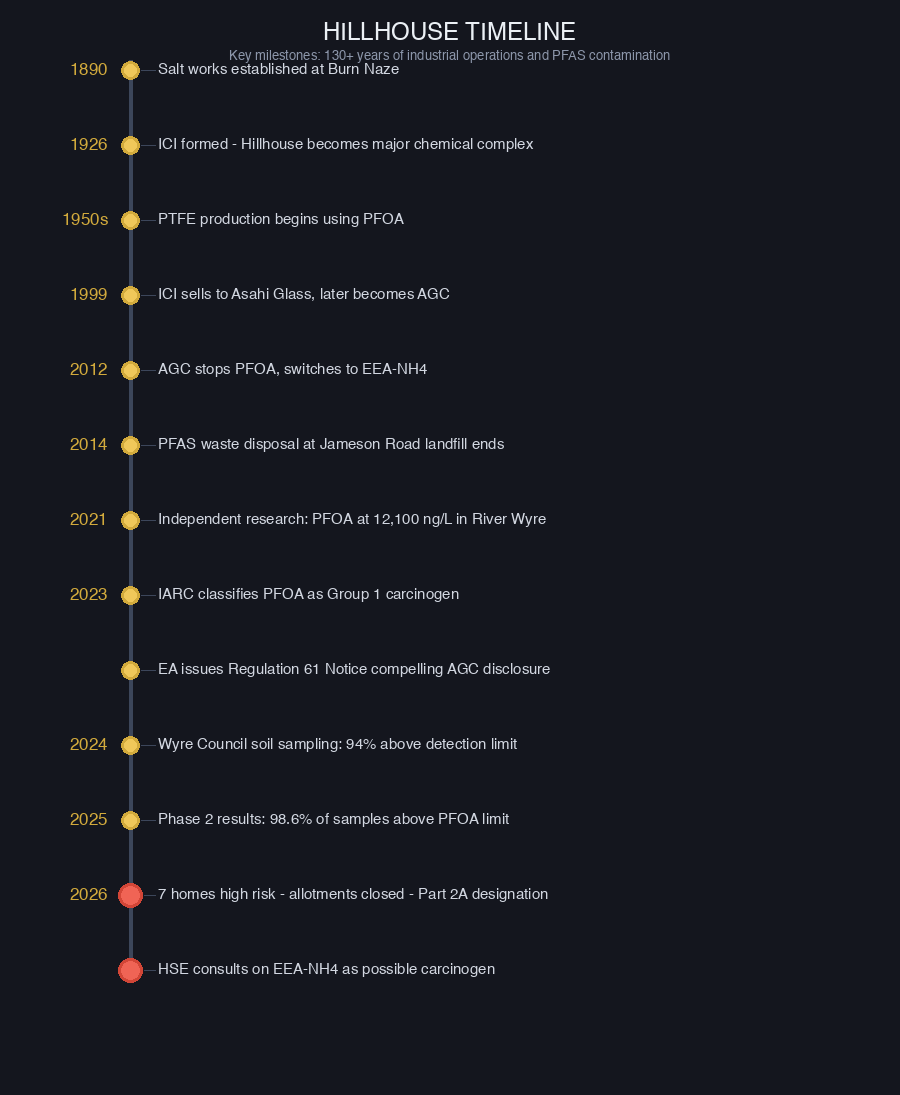
Part One: Industrial Origins (1890s–1941)
1890
The Fleetwood Salt Company establishes salt works at Burn Naze on the banks of the River Wyre, exploiting underground rock salt deposits at Preesall and Stalmine. This marks the beginning of large-scale industrial chemical operations on what will become the Hillhouse site.
Source: Visit Cleveleys; Groundsure PFAS article
c.1890
The United Alkali Company (UAC) acquires or absorbs the Fleetwood Salt Company’s operations almost immediately. UAC is one of Britain’s largest chemical manufacturers at the time, formed from earlier consolidations of soda-ash producers. It develops chlor-alkali works at Thornton/Burn Naze.
1926
Imperial Chemical Industries (ICI) is formed on 7 December from the merger of four major British chemical companies:
- Brunner, Mond & Co.
- Nobel Explosives Company
- United Alkali Company
- British Dyestuffs Corporation
The Hillhouse/Burn Naze works pass to ICI as part of this merger. ICI becomes one of the largest chemical companies in the world.
Source: ICI corporate history; Encyclopædia Britannica
1941
ICI’s General Chemicals Division acquires Hillhouse Works and Burn Hall Works from the Ministry of Supply — indicating the site had wartime strategic significance. Large-scale industrial expansion begins. ICI proceeds to develop one of the UK’s most significant chemical manufacturing complexes.
Source: ICI corporate history records
Part Two: The ICI Era — Growth and PFAS Introduction (1941–1999)
1950s
ICI begins manufacturing PTFE (polytetrafluoroethylene, trade name Fluon) at Hillhouse. PTFE production uses PFOA (perfluorooctanoic acid, also known as C8) as a polymerisation processing aid — a standard industry practice at the time.
PFOA is classified today as a Group 1 carcinogen (definite cause of cancer in humans) by the International Agency for Research on Cancer (IARC). It persists in the environment for an estimated 1,000+ years.
This is the start of PFOA use at Hillhouse. Emissions into the surrounding land, water, and air would continue for approximately 60 years.
Source: MEMORY.md; Dalmijn et al., ES&T 2025 (DOI: 10.1021/acs.est.5c07856)
1950s–1960s (Global context)
Both 3M (USA) and DuPont (USA) — the world’s leading PFAS manufacturers — begin developing internal knowledge that PFOA and PFOS are toxic, persistent, and bioaccumulative. Internal corporate documents later revealed in US litigation show this knowledge was not shared with regulators or the public.
Source: Documented in US litigation; see also Richter et al. (2025), PLOS One, on chemical industry concealment patterns (PMC11694934)
1961 (Global context)
DuPont’s own medical division documents internally that PFOA causes liver enlargement in rats at very low doses. This information is not published or shared with regulators. DuPont continues PFOA production for a further 50+ years.
Source: Documented in US litigation (Bilott v DuPont); reported by Robert Bilott, attorney, and in the film Dark Waters (2019)
1963 — Fire Fatality
26 July 1963: A fire breaks out in an electric furnace (anthracite heating for carbide production) at ICI Hillhouse. Seven firefighters are injured; Raymond Pearson (40) dies from injuries the following day.
Source: Institution of Fire Engineers records
1964
ICI restructures. The Mond Division is formed from the merger of the General Chemicals and Alkali Divisions, encompassing Hillhouse operations including chlorine and caustic soda production. Chlorine production at Hillhouse will peak at approximately 90,000 tonnes per year.
1978
ICI scientists invent PEEK (polyetheretherketone) polymer at Hillhouse — a high-performance engineering material that will become commercially significant worldwide.
1980s
ICI restructures again. Chemical and polymer operations are consolidated under ICI Chemicals and Polymers Ltd, which includes the Hillhouse fluoropolymers operation.
1988 (Global context)
3M’s internal research finds that PFOS accumulates in human blood at higher concentrations than previously understood. 3M continues manufacturing PFOS and PFOA products for a further 12 years before announcing phase-out in 2000.
Source: Documented in US regulatory proceedings and litigation
1988 — COMAH background
The Control of Major Accident Hazards (COMAH) Regulations will eventually apply to the Hillhouse site. ICI Hillhouse, as a major chemicals facility storing and processing large quantities of hazardous substances, would have been subject to predecessor legislation (the CIMAH Regulations 1984) throughout the 1980s and 1990s.
1992
ICI’s chlorine plant at Hillhouse ceases production after approximately 50 years of operation. The plant is subsequently demolished in 1994.
Source: ICI Hillhouse records (Wikipedia, confirmed against ICI corporate history)
1993
Victrex PLC is formed via a management buyout from ICI, taking the PEEK polymer business. Victrex remains based at Hillhouse to this day and shares a key site discharge point (Discharge Point W1) with AGC Chemicals Europe.
Source: Victrex corporate history; Dalmijn et al., ES&T 2025
1993 — ICI Demerger
ICI demerges its pharmaceuticals, agrochemicals, and specialties businesses into a new company, Zeneca Group PLC. What remains of ICI retains the bulk chemicals and fluoropolymers businesses, including Hillhouse. Zeneca subsequently merges with Sweden’s Astra AB to form AstraZeneca (1999).
Source: ICI/Zeneca/AstraZeneca corporate histories
Late 1990s
ICI announces it will sell Hillhouse site land to NPL Estates (Glasgow-based brownfield regeneration company) in a £50 million agreement. NPL describes itself as a “brownfield regeneration and remediation company.”
Source: NPL Estates corporate records; Teesside Live (2013)
1997–1999
ICI restructures and sells off further divisions. Huntsman Corporation (USA) acquires ICI’s polyurethane chemicals and selected petrochemicals businesses for approximately $2.8 billion. Polyurethane operations at Hillhouse are transferred. The fluoropolymers business at Hillhouse is not part of the Huntsman acquisition — it is retained for separate sale to Asahi Glass.
Part Three: Change of Ownership — Asahi Glass / AGC (1999–2012)
January 1999
Asahi Glass Company (Japan) purchases ICI’s 50% shareholding in the Asahi ICI Fluoropolymers (AIF) joint venture in Japan. This marks the beginning of AGC’s acquisition of ICI’s global fluoropolymers business.
Source: AGC news release, 26 January 1999
September 1999
AGC announces the purchase of all of ICI’s fluoropolymers business, including the Hillhouse plant, the Bayonne plant (USA), and the Thorndale plant (USA).
“AGC has decided to purchase all of ICI’s fluoropolymers business, aiming at global expansion of business.”
Source: AGC news release, 30 September 1999
December 1999
Transaction completed. The Hillhouse plant passes from ICI to Asahi Glass Fluoropolymers UK Limited, subsequently renamed AGC Chemicals Europe Ltd (Companies House: 03825057).
At the time of purchase, approximately 158 workers are employed at Hillhouse, and the site occupies some 2,200,000 m². AGC continues PTFE production using PFOA as a processing aid — as ICI had done for approximately 50 years.
Source: AGC acquisition documents; Companies House; ICI corporate records
2000 (Global context)
3M announces it will phase out PFOS and PFOA from all its products globally, citing environmental and health concerns. 3M had been the world’s primary manufacturer of these chemicals. The announcement is a significant moment in global PFAS awareness — but manufacturers in other countries, including AGC, continue using PFOA.
Source: US EPA records; widely reported
2000 — ICI Power Station
ICI’s Hillhouse power station continues operating on the site, though it is now redundant following ICI’s departure. The chimney — a local landmark — will remain standing until 2009.
2003
NPL Estates completes its purchase of the Hillhouse site land. AGC and Victrex (and other operators) become tenants/leaseholders on NPL-owned land. This creates an important division between the landowner (NPL) and the chemical operator (AGC).
Source: NPL Estates records; Wyre Council planning documents
2003 — COMAH
The Hillhouse site (including AGC Chemicals Europe) operates under the Control of Major Accident Hazards (COMAH) Regulations 1999 (which replaced CIMAH). The site is designated at an upper-tier level, reflecting the quantities of hazardous substances processed.
2005–2007 (AGC internal research)
AGC conducts internal studies on EEA-NH4 (the chemical it is developing as a PFOA replacement) at its Kurume Research Laboratories (Japan) and through WIL Research Laboratories (USA). These studies — all unpublished — cover environmental fate, bioconcentration in fish, and pharmacokinetics in rats and monkeys.
These studies are never published in peer-reviewed journals. They remain accessible only through later regulatory filings.
Source: EA Risk Evaluation for EEA-NH4 (April 2023), citing ECHA REACH registration dossier (ECHA, 2021a)
2006 — Environmental Permit
AGC Chemicals Europe Ltd receives an Environmental Permit (EPR/BU5453IY) from the Environment Agency for its Hillhouse operations. This permit, which will be varied and updated over subsequent years, contains no monitoring requirements for PFAS at any of the facility’s 15+ air emission points or discharge locations.
Source: EA Permit EPR/BU5453IY; permit analysis in Watch research archive
2006 (Global context)
Following years of US regulatory pressure, eight major manufacturers (including DuPont, 3M, and Asahi Glass) sign the US EPA’s PFOA Stewardship Program, voluntarily committing to phase out PFOA from products and manufacturing by 2015. Asahi Glass signs this agreement as a participant — meaning AGC’s US operations are publicly committed to PFOA phase-out.
At this point, the PFOA phase-out commitment covers US operations. The Hillhouse site in the UK continues to use PFOA.
Source: US EPA PFOA Stewardship Program; widely reported
2007 (Global context)
US attorney Rob Bilott files a class action lawsuit on behalf of approximately 3,500 residents near DuPont’s Washington Works plant in Parkersburg, West Virginia, where PFOA was manufactured. This follows his earlier personal injury cases from 1999 and is the landmark litigation that will eventually expose the full extent of DuPont’s internal knowledge.
Source: Bilott v DuPont; widely reported; documentary Dark Waters (2019)
2007 — ICI / AkzoNobel
Dutch paints company AkzoNobel acquires what remains of ICI plc for £8 billion ($15.8 billion). By this point ICI’s fluoropolymers business (including historical Hillhouse operations) has long since been sold to AGC. AkzoNobel acquires primarily the Dulux paints business. AkzoNobel does not acquire any operational interest in Hillhouse.
Source: AkzoNobel annual reports; ICI corporate history
2007 — Hillhouse chimney
ICI’s Hillhouse power station is demolished in 2007. The chimney — a visible local landmark — is demolished on 7 November 2009.
Source: ICI Hillhouse records (Wikipedia)
2008 — AGC rename
Asahi Glass Fluoropolymers UK Ltd is renamed AGC Chemicals Europe Ltd. The company continues operating at Hillhouse, manufacturing PTFE (approximately 4,000 tonnes per year) and ETFE (approximately 2,000 tonnes per year), using PFOA as a processing aid.
Part Four: Knowing the Risks — The PFOA Phase-Out (2008–2015)
2008
AGC self-classifies PFOA under REACH (EU chemicals regulation) as a Substance of Very High Concern (SVHC). This means AGC acknowledges, through the European chemicals regulatory system, that PFOA poses serious risks. PFOA use at Hillhouse continues for a further four years.
Source: ECHA REACH database (PFOA, CAS 335-67-1)
2009
PFOS (perfluorooctane sulfonate, closely related to PFOA) is listed under Annex B of the Stockholm Convention on Persistent Organic Pollutants, effectively triggering a global phase-out. This is a major international signal about the class of PFAS chemicals. PFOA is separately being reviewed.
Source: Stockholm Convention; UNEP
2009–2010 — DuPont litigation proceeds (Global context)
The US C8 Science Panel is established as part of the DuPont litigation settlement, tasked with investigating possible links between PFOA in drinking water and disease in 69,030 participants near DuPont’s Parkersburg plant. This is the largest PFAS health study ever conducted.
Source: C8 Science Panel records; Bilott, R., Exposure (2019)
2021 — Victrex / Veolia chemical spill — £80,000 fine
Victrex Manufacturing Limited and Veolia UK are ordered to pay a combined £80,000 after a chemical spill at the Hillhouse site. Two tanks containing hydrochloric acid and sodium hydroxide, located in the boiler house operated by Veolia under Victrex’s environmental permit, were overfilled. Both secondary and tertiary containment systems failed. Without intervention, the chemicals would have contaminated the River Wyre. The Environment Agency investigation confirmed that permit conditions were breached.
Source: Blackpool Gazette, 27 May 2021 — “Thornton companies ordered to pay £80k after chemical spill that could have contaminated River Wyre”
Note: Multiple site operators at Hillhouse make attribution of specific incidents important. Victrex manufactures PEEK polymer, not PFAS. However, this incident demonstrates the containment and regulatory compliance risks at the shared Hillhouse site.
2011 — AGC’s own reproductive toxicity data
AGC completes an unpublished reproduction/developmental toxicity screening test (OECD TG 421 protocol, GLP standard) on EEA-NH4 — the chemical it is planning to use as a PFOA replacement.
Results: reduced postnatal survival in rat pups at doses of 25 and 100 mg/kg/day; two dams experiencing total litter loss at 100 mg/kg/day.
Based on this data, AGC self-classifies EEA-NH4 as Reprotoxic Category 2 (H361d — “suspected of damaging the unborn child”) under REACH. This self-classification is registered with ECHA.
AGC therefore knew, before introducing EEA-NH4 at Hillhouse, that its own animal studies showed developmental harm at elevated doses. The substance is never the subject of an independent peer-reviewed toxicity study before being discharged into the River Wyre.
Source: EA Risk Evaluation EEA-NH4, April 2023 (citing ECHA, 2021a); EA Risk Evaluation, pp.56–58
2011 — EFSA food contact approval
EFSA (European Food Safety Authority) approves EEA-NH4 for use in food contact materials (19 May 2011), following an application by AGC. The human clearance time for EEA-NH4 in humans is not known.
Source: EA Risk Evaluation EEA-NH4 (April 2023), p.12
2012 — AGC stops using PFOA at Hillhouse
AGC Chemicals Europe ceases using PFOA as a processing aid at Hillhouse, replacing it with EEA-NH4. This follows AGC’s commitments under the US EPA PFOA Stewardship Program and growing regulatory pressure in Europe.
However, PFOA is not remediated from the surrounding environment. Because it was discharged to land, air, and water over approximately 60 years, it remains present in local soils, sediments, and watercourses — where it will persist for centuries.
PFOA continues to be detected in discharge water from the Hillhouse site at 20,624 ng/L as recently as 2023 — 206 times the EU drinking water standard — consistent with ongoing leaching from historically contaminated ground.
Source: AGC statement to Wyre Council (FAQ, October 2025); Dalmijn et al., ES&T 2025
2012 — EEA-NH4 introduced
EEA-NH4 (ammonium 2-(2-(1,2,2,2-tetrafluoroethoxy)-1-(trifluoromethyl)-1,2-difluoroethoxy)acetate; CAS 908020-52-0) begins use at Hillhouse as the PFOA replacement. It is discharged into the River Wyre at approximately 800 kilograms per year — a figure that remains essentially unchanged to the present day.
EEA-NH4 has two ether linkages in its structure, placing it in the class of perfluoroether carboxylic acids (PFECAs). Like PFOA, it does not break down naturally. Unlike PFOA, it has almost no peer-reviewed toxicological data in the public domain at the time of introduction.
Source: MEMORY.md; EA Risk Evaluation EEA-NH4 (April 2023); C&EN May 2023; Dalmijn et al. (2025)
2012 — AGC’s pre-competitive dumping at Jameson Road landfill ends
AGC Chemicals Europe legally dumps PFOA-containing waste at Jameson Road landfill (on the edge of Thornton-Cleveleys) until at least 2014 under consented waste disposal arrangements. Jameson Road has been used as a waste disposal site for the Hillhouse chemical complex since the 1940s under ICI, when it served as settlement lagoons for chemical effluent, described by one former ICI worker as “a lake of acid.”
Source: Guardian/Watershed Investigations, December 2025; former ICI worker account (Guardian, December 2025)
2012 (Global context)
C8 Science Panel (DuPont, USA) publishes its landmark findings: six diseases show “probable links” to PFOA exposure in the 69,030-person study population around Parkersburg, West Virginia:
- Kidney cancer
- Testicular cancer
- Ulcerative colitis
- Thyroid disease
- Hypercholesterolaemia (high cholesterol)
- Pregnancy-induced hypertension
This is the largest PFAS health study ever conducted and establishes the scientific basis for PFOA as a human carcinogen.
Source: C8 Science Panel, 2012; PMC2799461; PMC12014533
2013 — Victrex publishes at Hillhouse
Victrex PLC, the PEEK manufacturer at Hillhouse, remains the world headquarters and largest producer of PEEK polymer. Victrex shares infrastructure — including discharge point W1 — with AGC Chemicals Europe. This creates an attribution complexity for any discharge monitoring from that point.
Source: Victrex corporate records; Dalmijn et al. (2025)
2014
Wyre Council records suggest AGC’s legal disposal of PFOA-containing waste at Jameson Road landfill ends around this time.
Source: Guardian/Watershed Investigations, December 2025
2015 (Global context)
The US EPA PFOA Stewardship Program phase-out deadline is reached. Major US manufacturers have committed to eliminate PFOA from products and emissions. Global regulatory momentum against PFOA builds.
Part Five: The Science Catches Up — Environmental Detection (2015–2022)
2015 — Hillhouse Enterprise Zone
The UK government grants Enterprise Zone status to the Hillhouse site (announced November 2015; formally launched 1 April 2016). This brings financial incentives for businesses locating there and commits public support to the site’s continued industrial use.
Source: Wyre Council; government Enterprise Zone records
2017 — Major permit variation
The Environment Agency issues Variation V004 to AGC’s Environmental Permit (EPR/BU5453IY/V004, July 2017). This is the last major variation to the permit for several years. The variation does not introduce any monitoring requirements for PFAS in emissions.
Source: EA Permit EPR/BU5453IY/V004; permit analysis
2017 — Jameson Road landfill closes (first time)
Suez ceases operations at the Jameson Road landfill site. The site closes.
Source: Memory/timeline.md; Guardian December 2025
2019 (Global context) — Stockholm Convention lists PFOA
PFOA is listed as a Persistent Organic Pollutant (POP) under Annex A of the Stockholm Convention at the 9th Conference of the Parties (COP9, May 2019). This is the most significant international environmental treaty covering toxic chemicals, with 184 state parties. The listing requires all signatory states to eliminate PFOA production and use.
The UK, as a party to the Stockholm Convention, is bound by this obligation. Despite the listing, PFOA continues to be detected discharging from Hillhouse into the River Wyre.
Source: Stockholm Convention COP9, 2019; UNEP
2020 — EU Drinking Water Directive
The EU Drinking Water Directive 2020/2184 is adopted, setting a binding limit of 100 ng/L for total PFAS in drinking water (sum of PFAS), enforceable from 12 January 2026. The UK, having left the EU, does not adopt this standard. UK guidance on PFAS in drinking water remains non-statutory and less protective.
Source: EU Directive 2020/2184; CHEM Trust UK-vs-EU divergence analysis
2021 — River Wyre sampling data
Sampling at or near the River Wyre records 12,100 ng/L PFOA — a finding later published in peer-reviewed research. Separate data submitted by operators at Jameson Road to the Environment Agency records 11,000 ng/L PFAS/PFOA in fish in the River Wyre, and 12,100 ng/L in water near the site.
Source: Megson et al. (Chemosphere 2024, DOI: 10.1016/j.chemosphere.2024.143645); Transwaste-submitted data (Guardian, December 2025)
2021 — EA REACH dossier
The European Chemicals Agency (ECHA) publishes its REACH registration dossier for EEA-NH4 (ECHA, 2021a), incorporating the unpublished AGC toxicology studies from 2005–2011. This is the first time this data enters any public regulatory framework.
Source: EA Risk Evaluation EEA-NH4 (April 2023), citing ECHA 2021a
2022
Dr David Megson and colleagues at Manchester Metropolitan University begin detailed water sampling of the River Wyre near the Hillhouse facility, applying non-targeted analysis (NTA) to identify the full range of PFAS present.
Source: Megson et al., Chemosphere 2024
2022 (Global context) — Belgium 3M
The Belgian government orders 3M to halt PFOS production at its Zwijndrecht factory near Antwerp following the discovery of massive contamination in the surrounding area. Up to 70,000 residents are offered blood testing. A €571 million settlement is reached within a year.
This is the closest European precedent for the Hillhouse situation in scale and proximity to residential areas.
Source: Belgian government records; CHEM Trust; widely reported
Part Six: The Investigation Begins (2023–present)
February 2023 — First major media reporting
The Guardian and Watershed Investigations publish the first major investigative reporting on PFAS contamination at Hillhouse, revealing to the wider public:
- PFOA contamination in the River Wyre at levels far exceeding regulatory standards
- The site’s history of PFOA use under ICI and AGC
- AGC’s ongoing discharge of PFAS into the river
AGC spokesperson Halsall is quoted describing contamination levels as “unacceptable.”
Source: Guardian, February 2023 (local file: pfas-sources/guardian-2023-02-original.md) ✅ VERIFIED
April 2023 — Guardian: EEA-NH4 reporting
The Guardian publishes a follow-up investigation focused specifically on EEA-NH4, AGC’s replacement chemical for PFOA, which is still being discharged at approximately 800 kg/year into the River Wyre despite carrying a reproductive toxicity classification.
Source: Guardian, April 2023 (local file: pfas-sources/guardian-2023-04-eea-nh4.md) ✅ VERIFIED
April 2023 — Environment Agency risk evaluation
The Environment Agency publishes a formal risk evaluation for EEA-NH4 (Environmental risk evaluation report: Ammonium 2-(2-(1,2,2,2-tetrafluoroethoxy)-1-(trifluoromethyl)-1,2-difluoroethoxy)acetate). Key findings:
- EEA-NH4 classified as “very persistent” and “mobile”
- The human clearance time for EEA-NH4 is unknown — explicitly stated in the report
- Approximately 800 kg/year discharged to the River Wyre from Hillhouse
- AGC’s own H361d (Reprotoxic Category 2) self-classification confirmed
Source: EA Risk Evaluation EEA-NH4 (April 2023); local file: pfas-sources/papers/ea-risk-evaluations-2023/8-EEA-NH4.pdf ✅ VERIFIED
June 2023 (Global context)
3M announces a $10.3 billion national settlement in the USA to resolve claims relating to PFAS contamination of public water systems — the largest environmental settlement in US history at the time.
Source: Widely reported; C&EN; Guardian
November 2023 — IARC Group 1 classification
IARC (International Agency for Research on Cancer) classifies PFOA as a Group 1 carcinogen — the highest possible classification, meaning “carcinogenic to humans.” This is based on sufficient evidence of kidney cancer and testicular cancer in humans.
This classification is a significant regulatory trigger. It prompts the Environment Agency to review all permitted sites where PFOA is or has been present, and AGC’s historical emissions data (1950s–2012) is brought to the EA’s attention.
Source: IARC Monographs Volume 135 (November 2023); local file: pfas-sources/papers/iarc-pfoa-group1-classification-nov-2023.md ✅ VERIFIED
Late 2023 — EA review triggers Wyre Council investigation
Following the IARC Group 1 classification, the Environment Agency reviews all permitted sites. AGC’s historical emissions data comes to EA attention. The EA informs Wyre Borough Council of the PFOA contamination risk linked to Hillhouse. Wyre Council is described by its own Leader as “effectively compelled” to investigate under Part 2A of the Environmental Protection Act 1990.
Source: Cllr Michael Vincent (Leader, Wyre Council), ENDS Report, 3 March 2026 (Author: Pippa Neill; URL: https://www.endsreport.com/article/1950292) ✅ VERIFIED
2024 — EA internal report
An Environment Agency internal report (2024), subsequently obtained and reported by ENDS Report, estimates there could be as many as 10,000 PFAS hotspots across England. This places the Hillhouse investigation in a much broader national context.
Source: ENDS Report, 3 March 2026 (Pippa Neill); note — EA original report not independently obtained by Watch [PARTIAL — secondary source only]
Early 2024 — Megson et al. peer-reviewed paper
Dr David Megson (Manchester Metropolitan University) and colleagues publish their findings in Chemosphere — the first peer-reviewed study of PFAS contamination in the River Wyre near Hillhouse. Key findings:
- PFOA up to 12,100 ng/L in the River Wyre — one of the highest levels recorded in UK freshwater
- Total PFAS approximately 40 µg/L average; total organofluorine ~400,000 ng/L
- Between 89 and 1,175 distinct PFAS features identified using non-targeted analysis
- Novel compounds detected for the first time in UK freshwater, including U-PFECAs structurally related to EEA-NH4
- Only 8 PFAS (representing 17% of the peak area) are covered by the standard UK DWI 47-compound monitoring panel — meaning the vast majority of PFAS at this location are not routinely tested for
Source: Megson et al. (Chemosphere 2024); DOI: 10.1016/j.chemosphere.2024.143645 ✅ VERIFIED
September–October 2024 — Phase 1 soil sampling
WSP consultants, commissioned by Wyre Borough Council as part of the Part 2A investigation, carry out Phase 1 soil sampling of council-owned land within approximately 5km of the Hillhouse facility. Results:
- 199 samples collected across 63 locations
- 187 of 199 samples (approximately 94%) are above detection limits for PFOA
- Peak: 35.1 µg/kg
- Contamination is distributed across a wide area, well beyond the site boundary
Source: Wyre Council Phase 1 Factual Report (WSP, 2024); local files in ~/clawd/memory/pfas-sources/ ✅ VERIFIED
October 2024 — AGC PFOS statement
AGC Chemicals Europe Ltd states in Wyre Council FAQ documentation (October 2025) that it has “never used or manufactured PFOS.” However, PFOS is subsequently found in egg samples from properties near the site (February 2026). The source of PFOS at the location remains unresolved — possible sources include other site operators, Jameson Road landfill, firefighting foams, or transformation of PFOS precursor compounds.
Source: Wyre Council FAQ, October 2025; Leigh Day egg test results, February 2026
December 2024 — Academic paper confirms EEA-NH4 in environment
Dalmijn, Cousins et al. publish in Environmental Science & Technology the first peer-reviewed detection of EEA-NH4 in the environment — confirmed in discharge water from the Hillhouse site. Key findings:
- PFOA: 20,624 ng/L at AGC discharge point W1 — 206 times the EU drinking water standard
- EEA-NH4: 1,744 ng/L at discharge point W2 — first environmental detection ever recorded
- PFOA detected in air samples at Hazelrigg, 20 km from the site — confirming airborne transport
- EEA-NH4 detected in air — the first measurement of EEA-NH4 in air anywhere in the world
- Novel H-PFCAs and Cl-PFCAs identified for the first time in Europe
- Environment Agency estimate of total emissions from Hillhouse (all operators): approximately 145 tonnes (75t to water, 70t to air) — though other sources citing EA/FOI data put the figure at 178 tonnes
The paper confirms Victrex PLC shares discharge point W1 with AGC Chemicals Europe.
Source: Dalmijn, Cousins et al. (ES&T 2025); DOI: 10.1021/acs.est.5c07856; PMC: PMC12312159 ✅ VERIFIED
January 2025 — Planning moratorium refused
Wyre Council Leader Cllr Michael Vincent writes to the government in January 2025 requesting authority to defer all planning applications within 1km of Hillhouse pending the contamination investigation. Baroness Sharon Taylor (MHCLG) responds that existing NPPF powers allow case-by-case contamination assessment requirements — but does not grant a blanket moratorium.
Source: Central Radio North West, 28 March 2025; Wyre Council records
Early 2025 — EEA-NH4 emissions data
Environment Agency data cited in the ENDS Report (March 2026) indicates AGC discharges 793 kg/year of EEA-NH4 to the River Wyre and less than 1 tonne/year to air (2023 data). AGC claims abatement measures have reduced emissions to 0.009% of former levels to air and 0.001% to water — but does not provide a baseline figure against which these percentages are measured.
Source: ENDS Report (Pippa Neill, 9 March 2026)
March 2025 — Wyre Council vegetables advice
Wyre Council advises residents within 1km of the Hillhouse site not to eat home-grown vegetables until further sampling is complete. CHEM Trust covers this development, marking one of three direct coverages of the Hillhouse/AGC situation by the UK’s leading chemicals NGO.
Source: CHEM Trust news; Wyre Council communications
27 March 2025 — Transwaste suspension
The Environment Agency issues a suspension notice requiring Transwaste Recycling & Aggregates Ltd to stop accepting landfill waste at the Jameson Road landfill until new gas extraction infrastructure is installed. By this point EA has documented 70 permit breaches by Transwaste at this site. Separate EA sampling of Jameson Road leachate confirms the presence of PFAS contamination emanating from the south side of the landfill.
Source: Memory/timeline.md; Guardian December 2025; Wyre Council records
July 2025 — Phase 2 soil sampling report published
WSP publishes the Phase 2 Factual Report for Wyre Council (dated 17 July 2025). This is the most comprehensive soil survey yet conducted. Key findings:
- 291 samples across 63 locations within approximately 500m of the AGC facility
- 287 of 291 samples (98.6%) are above the detection limit for PFOA
- Peak PFOA concentration: 144 µg/kg at sample GR01-SP232 (0.4–0.5m depth)
- Average: 4.18 µg/kg; Median: 2.71 µg/kg
- Contamination increases with depth — at 0.4–0.6m depth, concentrations are higher than at surface — indicating subsurface migration and not just surface deposition
- Sampling stops at 0.6m, where contamination is still increasing; the true depth of contamination is unknown
Source: WSP Phase 2 Factual Report, Wyre Borough Council, 17 July 2025; local file ~/clawd/memory/pfas-sources/phase2-factual-report.pdf ✅ VERIFIED
July 2025 — CHEM Trust “hotspots” coverage
CHEM Trust publishes on the Hillhouse situation as part of a broader piece on UK PFAS hotspots, confirming national NGO awareness of the Thornton-Cleveleys investigation.
Source: CHEM Trust; https://chemtrust.org/news/something_in_the_water_pfas_hotspots/
~August 2025 — AGC tree felling
AGC fells trees along approximately 10 metres of the boundary between the Hillhouse site and adjacent residential properties. Felled biomass is left in place to decompose. No prior notification is given to neighbouring residents. The tree line is felled in the zone identified by the Phase 2 survey as having elevated contamination, and within the 0–0.6m depth layer where contamination concentration profiles are highest. No public environmental management plan for this work is disclosed.
Source: Resident observation; Watch research archive; Phase 2 data
August 2025 — Beavers AGC visit
Lorraine Beavers MP (Labour, Blackpool North and Fleetwood) visits AGC Chemicals Europe at the Hillhouse site and publishes a social media post. The post is subsequently deleted. Prior to deletion, it is documented and preserved.
Source: Preserved record in Watch archive; local file: pfas-sources/beavers-agc-visit-19aug2025-deleted.md ✅ VERIFIED
September 2025 — AGC permit compliance failures
AGC’s own compliance monitoring (September 2025) records:
- Dioxins: 0.37 µg/Nm³ against a permit limit of 0.10 µg/Nm³ (3.7× the permitted limit)
- Particulates: 1,407 mg/m³ against a permit limit of 30 mg/m³ (47× the permitted limit)
- The thermal oxidiser — a key emission control device — was offline for 43 days in the first two quarters of 2025
These are permit breaches for non-PFAS pollutants. It is not known whether these are also indicative of elevated PFAS releases during oxidiser downtime, as no PFAS monitoring is required by the permit.
Source: EA permit compliance records; Watch research archive
September 2025 — Permit variation
The Environment Agency issues permit variation RD-20250930 to AGC’s Environmental Permit. The variation does not introduce PFAS monitoring requirements.
Source: EA Permit variation September 2025; local file: pfas-sources/papers/agc-permit-sept2025.txt ✅ VERIFIED
October 2025 — Wyre Council FAQ published
Wyre Council publishes a FAQ document about the contamination investigation (October 2025), including AGC’s statements that the company stopped using PFOA in 2012 and has “no significant impact” from current emissions, and that it has “never used or manufactured PFOS.”
Source: Wyre Council FAQ, October 2025
16 October 2025 — Leigh Day community town hall
Leigh Day solicitors hold a community town hall meeting in Thornton-Cleveleys on potential legal action relating to PFAS contamination from the Hillhouse estate. This is the first Leigh Day-organised community meeting on the Hillhouse PFAS contamination.
Source: Leigh Day event page, October 2025; URL: https://www.leighday.co.uk/news/events/agc-chemicals-and-pfas-meeting-on-potential-legal-action/ ✅ VERIFIED
October 2025 — Beavers ChemTrust
Lorraine Beavers MP meets with CHEM Trust (ChemTrust) in October 2025. CHEM Trust is the UK’s leading chemicals safety NGO. At a prior meeting at the Labour Party Conference (September 2025), Sarah Moore (Leigh Day partner) was also present and Beavers expressed intent to make Thornton-Cleveleys a “template” for community-led environmental resolution.
Source: Beavers-ChemTrust meeting, October 2025; local file: pfas-sources/beavers-chemtrust-oct2025.md ✅ VERIFIED
December 2025 — Permit variation
The Environment Agency issues permit variation RI-20251217 to AGC’s Environmental Permit. This is the most recent permit variation on record. No PFAS monitoring conditions are introduced.
Source: EA Permit variation December 2025; local file: pfas-sources/papers/agc-permit-dec2025.txt ✅ VERIFIED
December 2025 — Guardian on Jameson Road
The Guardian and Watershed Investigations publish an investigation linking Jameson Road landfill, AGC’s historic PFOA waste disposal, ICI’s historic lagoon use, and high PFAS levels in the River Wyre. Dr David Megson (Manchester Metropolitan University) is quoted. A former ICI worker describes the site as containing “a lake of acid.”
Key data from the article:
- AGC legally disposed of PFOA-containing waste at Jameson Road landfill until approximately 2014
- ICI used the Jameson Road area as chemical settlement lagoons from the 1940s, unlined, including multiple types of industrial effluent
- River Wyre sampling at or near Jameson Road: 12,100 ng/L PFAS/PFOA in water; 11,000 ng/L in fish
Source: Guardian/Watershed Investigations, 2 December 2025 ✅ VERIFIED
Part Seven: Residents Informed — Investigation Accelerates (2026)
3 February 2026 — UK PFAS Plan
The UK Government publishes its first national PFAS strategy, titled “Building a Safer Future Together” (DEFRA, 3 February 2026). The plan sets out a framework covering three pillars: understanding sources, tackling pathways, and reducing exposure.
Key limitations:
- EEA-NH4 is not mentioned in the plan
- No statutory limits on PFAS in soil, air, or water are established
- No specific enforcement timeline for existing discharge permits
- No commitment to fund community blood testing for affected communities
- The plan is widely criticised by environmental groups as insufficient
Source: Gov.uk (3 February 2026); local file: memory/sources/defra-pfas-plan-2026-02-03.md ✅ VERIFIED; CHEM Trust analysis
February 2026 — Egg testing results
Leigh Day solicitors arrange testing of eggs from domestic poultry kept within 1km of the Hillhouse facility. Results from four properties:
- All four properties’ eggs exceed the EFSA safe limit of 4.4 µg/kg (cumulative PFAS4)
- Worst result: duck eggs at one property at 46 µg/kg — 10.5 times the EFSA safe limit
- Both PFOA and PFOS are detected — despite AGC’s statement that it has never used or manufactured PFOS
The presence of PFOS requires separate explanation. Potential sources include Jameson Road landfill, other Hillhouse operators, firefighting foam use, or transformation of PFOS precursor compounds.
Source: Leigh Day egg test results, 17 February 2026; local file: pfas-sources/leigh-day-egg-results-2026-02-17.md ✅ VERIFIED
10 February 2026 — Guardian op-ed
Journalist Pippa Neill (ENDS Report news editor) publishes a commentary in The Guardian describing the duck egg contamination in Thornton-Cleveleys (“Sam”) and contrasting the UK’s fragmented PFAS approach with the EU’s developing blanket ban. She describes EEA-NH4 — still being discharged from Hillhouse — as “new PFAS chemical not mentioned in the PFAS Plan.”
Source: Guardian, 10 February 2026 (Pippa Neill); URL: https://www.theguardian.com/commentisfree/2026/feb/10/eu-ban-forever-chemicals-britain-lancashire-government-pfas ✅ VERIFIED
February 2026 — Leigh Day begins broader public engagement
Leigh Day solicitors (Sarah Moore, partner; Tom Sinclair, trainee) have been investigating potential claims against AGC Chemicals Europe since 2025. In early 2026 they begin broader public engagement with affected residents. The legal theory is private nuisance on a continuing basis — because PFAS contamination is ongoing, there is no limitation period. Leigh Day are also actively investigating a separate PFAS case at Bentham, North Yorkshire (Angus Fire factory).
Source: Leigh Day public statements; ITV Granada, 12 March 2026
February 2026 — Residents learn of their soil results
Wyre Council begins writing to individual residents within the Phase 3 investigation area (residential properties) with their own soil sampling data. Results confirm blanket contamination across properties, with 100% of samples at one property exceeding the Dutch PFOA soil screening value of 3.8 µg/kg. The Dutch threshold is the internationally used reference point — the UK has no equivalent statutory threshold.
The peak residential result recorded is 119 µg/kg — 31.3 times the Dutch threshold.
Contamination profiles at residential properties show contamination increasing with depth, consistent with ongoing subsurface migration from the Hillhouse site. Sampling stops at 0.6m, so the true depth of contamination beneath residential gardens is not established.
Source: Wyre Council Phase 3 communications (letters dated 27 February 2026); WSP soil data ✅ VERIFIED
2 March 2026 — Wyre Council announces Phase 3 results
Wyre Council publishes an update confirming Phase 3 soil sampling at residential properties near Hillhouse. A “small number” of properties “may need further assessment.” No Part 2A (contaminated land) designation is made at this stage for any residential land.
Source: Wyre Council, Article 599, 2 March 2026; URL: https://www.wyre.gov.uk/news/article/599/residents-updated-following-completion-of-latest-phase-of-soil-sampling ✅ VERIFIED
3 March 2026 — Wyre Council Leader calls government “asleep at the wheel”
ENDS Report publishes an interview with Cllr Michael Vincent, Leader of Wyre Borough Council. Vincent:
- Calls the EA and government “asleep at the wheel” on PFAS
- Describes Wyre Council as a “guinea pig for PFOA”
- Says the UK government’s PFAS Plan is “not fit for purpose”
- Demands government-funded blood testing for residents
- Describes the council as having been “effectively compelled” to investigate following EA involvement
The same article confirms the investigation origin chain: IARC Group 1 classification (November 2023) → EA site review → AGC historical data → Council “compelled” to investigate under Part 2A.
Source: ENDS Report, 3 March 2026 (Pippa Neill); URL: https://www.endsreport.com/article/1950292 ✅ VERIFIED
4 March 2026 — Leigh Day: seven homes identified as high risk
Leigh Day solicitors announce that of 71 properties tested in Phase 3, seven are identified as high risk requiring further investigation. Sarah Moore (Leigh Day partner) is quoted citing the WHO PFOA carcinogen classification. Leigh Day announces a community town hall meeting planned for late May 2026 at Thornton-Cleveleys FC.
Source: Leigh Day press release, c.4 March 2026; URL: https://www.leighday.co.uk/news/press-releases/2026-news/seven-homes-identified-as-high-risk-due-to-pfas-contaminated-soil-in-thornton-cleveleys/ ✅ VERIFIED
5 March 2026 — First Part 2A contaminated land recommendation
The Environment Agency formally recommends to Wyre Borough Council that Occupation Road allotments should be designated as “Contaminated Land” under Part IIA of the Environmental Protection Act 1990. This is based on PFOA contamination in both soil samples and in produce grown on the allotments.
Wyre Council closes Occupation Road allotments with immediate effect. Sandringham Avenue allotments are also temporarily closed on a precautionary basis.
This is the first Part 2A contaminated land recommendation arising from the Thornton-Cleveleys PFAS investigation. Once formally designated, it creates a legal requirement for the identification of “appropriate persons” responsible for remediation.
Source: Wyre Council, Article 601, 5 March 2026; URL: https://www.wyre.gov.uk/news/article/601/further-steps-taken-in-ongoing-multi-agency-investigation ✅ VERIFIED; Leigh Day monthly update, 27 March 2026
5 March 2026 — BBC News coverage
BBC News covers both developments: seven high-risk homes and the allotment closure. The story includes Wyre Council Leader Michael Vincent’s comments on liability and the community impact. BBC coverage is the first time the Thornton-Cleveleys contamination reaches a mainstream national audience at scale.
Source: BBC News, c.5 March 2026; URL: https://www.bbc.co.uk/news/articles/c5y4909np13o ✅ VERIFIED
9 March 2026 — HSE opens consultation on EEA-NH4 classification
Health and Safety Executive (HSE) launches a public consultation proposing to classify EEA-NH4 as a Category 2 carcinogen (possible carcinogen) and Category 1b reproductive toxin under GB CLP (Classification, Labelling and Packaging) regulations. The classification is based on liver and kidney effects in rat studies (28-day and longer-term studies).
If confirmed, this would be a formal regulatory acknowledgement that EEA-NH4 — which AGC continues to discharge at approximately 800 kg/year into the River Wyre — poses cancer and reproductive risks.
AGC disputes the proposed classification, stating it has engaged third-party experts who support its position. Dr Shubhi Sharma (ChemTrust) welcomes the proposed classification.
The consultation closes 1 May 2026.
Source: ENDS Report, 9 March 2026 (Pippa Neill); confirmed against HSE consultation records ✅ VERIFIED
12 March 2026 — ITV Granada report
ITV Granada News reports: “Residents take legal action after cancer-causing contamination risk.” Sarah Moore (Leigh Day, partner) is interviewed. Wyre Council Leader Michael Vincent is featured; he supports community blood testing. The HSE EEA-NH4 carcinogen classification consultation is covered.
Source: ITV Granada, 12 March 2026; URL: https://www.itv.com/news/granada/2026-03-12/residents-take-legal-action-after-cancer-causing-contamination-risk ✅ VERIFIED
12 and 17 March 2026 — Community drop-in sessions
Multi-agency drop-in sessions take place at Thornton-Cleveleys Football Club (Gamble Road), 4pm–7pm on both dates. Attending agencies include the Environment Agency, UKHSA, Food Standards Agency, and Lancashire County Council. The sessions are attended by many local residents, with questions about blood testing, property impact, and contamination extent.
Source: Wyre Council communications; Leigh Day monthly update, 27 March 2026
14 March 2026 — MP attends Multi-Agency meeting
Lorraine Beavers MP (Labour, Blackpool North and Fleetwood) attends the Multi-Agency meeting on the Hillhouse investigation. She confirms her attendance in writing on 16 March 2026.
Source: Lorraine Beavers MP, email 16 March 2026
17 March 2026 — Critical dual-permit structure identified
Research identifies that the Hillhouse discharge points are covered by two separate permit structures from two separate entities:
- AGC Chemicals Europe Ltd holds Environmental Permit EPR/BU5453IY — the main process permit
- Thornton Facilities Management Ltd (Companies House 04673430) holds separate discharge consents (017290033 for Wyre Estuary; 017290384 for Royles Brook)
Critically, Permit 017290384 for Royles Brook was issued on 21 January 1999 and has never been updated — 27 years, spanning the entire AGC era, all permit variations, the Stockholm Convention listing of PFOA, and the IARC Group 1 classification. Neither AGC’s permit nor Thornton FM’s permits contain any PFAS monitoring conditions.
Source: EA permit records; Companies House; Watch research archive (memory/2026-03-17.md) ✅ VERIFIED
19 March 2026 — First parliamentary question on PFAS/Hillhouse
Lorraine Beavers MP raises the Thornton-Cleveleys PFAS contamination in the House of Commons during Business of the House (Volume 782). She asks the Leader of the House to make time for a debate on “the need to ensure that polluters pay for the clean-ups needed in cases like this.”
Leader of the House Sir Alan Campbell responds that he will ensure the relevant minister hears her concerns and writes to her.
This is the first time the Hillhouse/PFOA contamination has been raised on the Parliamentary record by the constituency MP.
Source: Hansard, 19 March 2026; URL: https://hansard.parliament.uk/Commons/2026-03-19/debates/F59C36F0-1C73-43CE-9058-1900953C1C9B/BusinessOfTheHouse ✅ VERIFIED
19 March 2026 — DEFRA escalation
Lorraine Beavers MP confirms she will pass residents’ questions about Hillhouse/PFAS to the Secretary of State for Environment, Food and Rural Affairs (DEFRA) for a departmental response. This is the first time Hillhouse/PFAS questions have been formally escalated to Cabinet Secretary level.
Source: Lorraine Beavers MP, email 19 March 2026
~22 March 2026 — ITV documentary: In Our Blood
ITV1 broadcasts In Our Blood: The Forever Chemicals Scandal (ITV Exposure documentary). The film focuses primarily on Bentham, North Yorkshire (Angus Fire firefighting foam factory) but situates it in the wider UK and global PFAS context. Blood testing of 39 Bentham residents and former workers shows:
- Highest level: 405 ng/ml (202 times the NASEM lower exposure threshold of 2 ng/ml)
- 23% of participants above 20 ng/ml — the highest NASEM risk category
- Two-thirds of participants in the top 5% of the US reference population
- Younger participants showing higher levels than adults, consistent with transplacental and breast milk transfer
Dr David Megson (Manchester Metropolitan University) — the same researcher who documented PFAS contamination in the River Wyre near Hillhouse — analyses the blood results.
Source: ITV, c.22 March 2026; URL: https://www.itv.com/watch/in-our-blood-the-forever-chemicals-scandal-exposure/10a7502a0001B/10a7502a0001; Guardian review 22 March 2026 ✅ VERIFIED
27 March 2026 — Leigh Day monthly update: AGC’s own investigation
Leigh Day’s monthly community update (27 March 2026) confirms:
- AGC Chemicals Europe is running its own on-site investigation in partnership with the Environment Agency
- Leigh Day has issued a Freedom of Information request to obtain details of this investigation
- Seven residential properties remain designated “high risk” with further investigation promised but no concrete timeline given
- Phase 3 full factual and iterative risk assessment reports are expected after Easter (week commencing 7 April 2026)
- Phase 3 is the final phase of soil testing — no further residential soil sampling is planned
Source: Leigh Day monthly update email, 27 March 2026 ✅ VERIFIED
March 2026 — Leigh Day town hall planned
Leigh Day solicitors announce a second community town hall meeting, planned for late May 2026 at Thornton-Cleveleys FC. Details to be confirmed before the end of April 2026. The first Leigh Day community meeting was held on 16 October 2025.
Source: Leigh Day monthly update, 27 March 2026; Leigh Day press release, March 2026
Key Sources and Citations
Where specific documents are cited, the citation is indicated in the relevant entry. A selection of primary sources underlying this timeline:
| Source | Details |
|---|---|
| Dalmijn, Cousins et al. (2025) | Environmental Science & Technology; DOI: 10.1021/acs.est.5c07856; PMC12312159 |
| Megson et al. (2024) | Chemosphere; DOI: 10.1016/j.chemosphere.2024.143645 |
| EA Risk Evaluation — EEA-NH4 (2023) | Environment Agency, April 2023 |
| IARC Monographs Vol. 135 (2023) | PFOA Group 1 carcinogen classification |
| WSP Phase 2 Factual Report (2025) | Wyre Borough Council, 17 July 2025 |
| C8 Science Panel (2012) | PFOA probable link diseases, DuPont/Parkersburg |
| Stockholm Convention COP9 (2019) | PFOA listed as POP |
| Wyre Council news articles 599, 601 (2026) | Contaminated land process |
| Leigh Day press release (March 2026) | Seven homes high risk |
| Hansard, 19 March 2026 | First parliamentary question |
| ENDS Report, 3 March 2026 (Pippa Neill) | Vincent interview |
| Guardian, February and April 2023 | Original Watershed Investigations reporting |
| Guardian, December 2025 | Jameson Road investigation |
| ITV Granada, 12 March 2026 | Legal action coverage |
Notes on This Timeline
- This timeline will be updated as the investigation progresses. The Phase 3 full reports (expected April 2026), the HSE consultation outcome (May 2026), any DEFRA ministerial response, and the Leigh Day town hall (May 2026) are all significant upcoming dates.
- Items marked [UNVERIFIED] represent information not confirmed against a primary source. We have attempted to be conservative — where a source is partial or secondary, this is noted.
- This timeline focuses on the Hillhouse site and the Thornton-Cleveleys community. It does not cover all PFAS contamination in the UK or globally, though it notes key international precedents and regulatory milestones where directly relevant.
- The contamination at Jameson Road landfill (PFAS, odour, leachate) is a related but separate matter from the Hillhouse site itself and is noted here for context.
Last updated: March 2026. For corrections or additional information, use the contact page.